
- Ambulance
- Out of Time
- Crazy Beat
- Good Song
- On the Way to the Club
- Brothers and Sisters
- Caravan
- We’ve Got a File on You
- Moroccan Peoples Revolutionary Bowls Club
- Sweet Song
- Jets
- Gene by Gene
- Battery in Your Leg
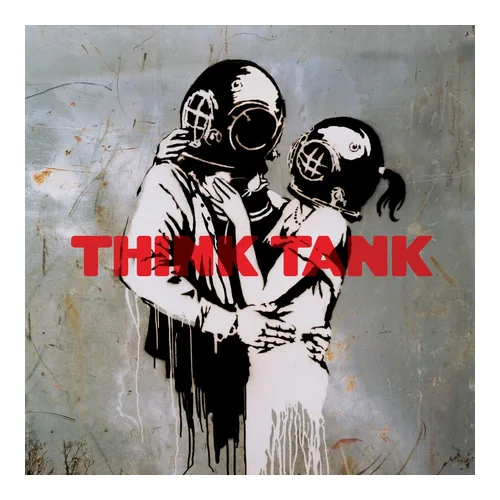
Septième album studio de Blur, Think Tank paraît le 5 mai 2003 chez Parlophone, dans un contexte marqué par le départ du guitariste Graham Coxon en cours d’enregistrement. Porté par les explorations électroniques et les influences du monde entamées sur 13, l’album s’éloigne du Britpop des débuts du groupe pour lorgner vers la dance, le hip-hop, le dub et les musiques africaines. Sa pochette, un pochoir signé par l’artiste britannique Banksy, installe d’emblée un climat à la fois tendre et inquiet, en résonance avec les thèmes de l’amour, de la politique et de l’aliénation contemporaine qui traversent le disque.
L’enregistrement de Think Tank débute en novembre 2001 au 13 Studio de Damon Albarn à Londres, sans Graham Coxon, alors en cure de désintoxication. Le reste du groupe travaille d’abord sur des maquettes avant que Coxon ne rejoigne ponctuellement les sessions début 2002, dans une ambiance tendue qu’il qualifiera lui-même de pesante ; il ne contribuera finalement qu’au titre « Battery in Your Leg ». Les sessions se poursuivent au Maroc, où le groupe installe un studio dans une grange et enregistre notamment « Crazy Beat », « Gene by Gene » et « Moroccan Peoples Revolutionary Bowls Club », avant de s’achever dans une ferme du Devon fin 2002. La production est assurée principalement par Ben Hillier, avec des contributions de Norman Cook (Fatboy Slim) et William Orbit. Pour la pochette, le groupe commande à Banksy, artiste peu enclin aux travaux commerciaux, un pochoir représentant deux silhouettes casquées de scaphandres anciens, attablées autour d’un verre de vin sous un cœur rose dégoulinant ; l’œuvre est photographiée par Steve Lazarides sur un terrain de gens du voyage à Deptford, à Londres.
Sur le plan musical, Think Tank délaisse les guitares saturées au profit de nappes électroniques, de boucles rythmiques échantillonnées et de textures dub, jazz et africaines, dans la continuité du travail parallèle d’Albarn avec Gorillaz et Mali Music. L’absence de Coxon renforce le rôle de la section rythmique d’Alex James et Dave Rowntree, tandis qu’Albarn assure l’essentiel des parties de guitare acoustique. Visuellement, le pochoir de Banksy tranche par sa économie de moyens et son ton mélancolique, loin de l’imagerie pop habituelle des pochettes de Blur, tout en faisant écho à des motifs récurrents dans le travail de l’artiste — figures isolées, symboles d’intimité fragile, esthétique urbaine brute empruntée au street art londonien.
Think Tank reçoit un accueil critique globalement favorable, salué pour la maturité de l’écriture d’Albarn et l’intégration réussie des éléments électroniques et world music, même si certains observateurs regrettent l’absence du jeu de guitare de Coxon. L’album entre directement en tête des charts britanniques, offrant à Blur un cinquième numéro un consécutif et une certification disque d’or, tout en devenant à l’époque leur meilleure entrée sur le Billboard américain. Think Tank remporte le prix du meilleur album aux Q Awards 2003 et figure plus tard à la vingtième place du classement des meilleurs albums de la décennie établi par NME. La pochette de Banksy, longtemps restée un symbole de cette période du groupe, est revendue aux enchères en 2007 pour 75 000 livres sterling.
Blur’s seventh studio album, Think Tank, was released on May 5, 2003, through Parlophone, arriving amid guitarist Graham Coxon’s departure partway through recording. Building on the electronic and global influences first explored on 13, the album moves away from the band’s early Britpop sound toward dance, hip-hop, dub and African music. Its cover, a stencil by British artist Banksy, sets a tender yet unsettled tone from the outset, echoing the record’s themes of love, politics and contemporary alienation.
Think Tank’s recording began in November 2001 at Damon Albarn’s 13 Studio in London, without Graham Coxon, who was then in rehabilitation. The rest of the band worked on demos before Coxon briefly rejoined sessions in early 2002, in an atmosphere he later described as tense; he ultimately contributed only to the track « Battery in Your Leg. » Sessions continued in Morocco, where the band set up a studio in a barn and recorded « Crazy Beat, » « Gene by Gene » and « Moroccan Peoples Revolutionary Bowls Club, » before wrapping up at a farm in Devon by late 2002. Production was handled primarily by Ben Hillier, with additional contributions from Norman Cook (Fatboy Slim) and William Orbit. For the cover, the band commissioned Banksy, an artist generally reluctant to take on commercial work, to create a stencil depicting two figures in antique diving helmets seated at a table with a glass of wine, beneath a dripping pink heart; the artwork was photographed by Steve Lazarides on a traveller site in Deptford, London.
Musically, Think Tank sets aside distorted guitars in favor of electronic textures, sampled rhythm loops, and dub, jazz and African-inflected sounds, continuing in parallel with Albarn’s work on Gorillaz and Mali Music. Coxon’s absence pushed the rhythm section of Alex James and Dave Rowntree further to the fore, while Albarn handled most of the acoustic guitar parts himself. Visually, Banksy’s stencil stands out for its spare composition and melancholic tone, a departure from Blur’s usual pop imagery, while echoing recurring motifs in his broader body of work — isolated figures, symbols of fragile intimacy, and the raw urban aesthetic of London street art.
Think Tank received largely favorable reviews, with critics praising the maturity of Albarn’s songwriting and the successful integration of electronic and world-music elements, though some noted the absence of Coxon’s guitar work. Think Tank debuted at number one on the UK charts, giving Blur their fifth consecutive chart-topping album and a Gold certification, while also becoming their highest-charting entry on the Billboard 200 at the time. It won Best Album at the 2003 Q Awards and later placed twentieth on NME’s list of the best albums of the decade. Banksy’s cover artwork, long associated with this period of the band, was later resold at auction in 2007 for £75,000.