

- Opening
- Imagine
- The March
- Time Machine
- Eclipse
- Entrance to Metropolis
- Keaton’s Theme
- Daylight
- The Bells
- Gamma Player
- 4 Art
- Medium C: The Urge to Swirl Alone in a Pool of Ridicule
- Amazon
- See This Way
- Sonic Destroyer
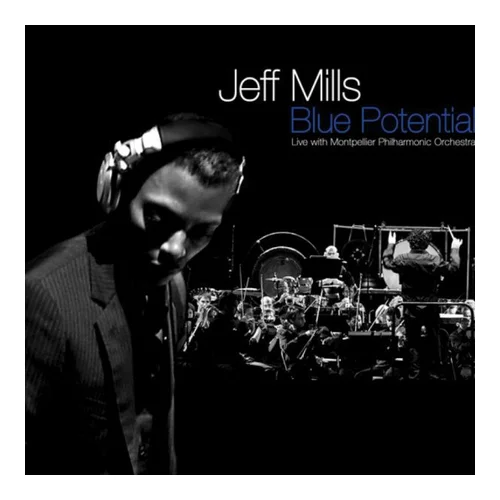
Blue Potential (Live With Montpellier Philharmonic Orchestra) est un album du DJ et producteur techno américain Jeff Mills, figure fondatrice du label Underground Resistance puis d’Axis Records. Sorti d’abord aux États-Unis en 2005 via UWe, puis en 2006 en Europe notamment chez Tresor, ce disque documente un concert associant machines électroniques et orchestre symphonique. Il rassemble quinze relectures orchestrales de morceaux emblématiques du catalogue de Mills, arrangées par le compositeur Thomas Roussel et dirigées par le chef Alain Altinoglu. L’ambition : faire dialoguer la rigueur mécanique de la techno avec la texture organique d’un orchestre classique.
Le projet naît d’une performance live donnée en juillet 2005 sous le Pont du Gard, près d’Avignon, lors d’un concert gratuit réunissant Jeff Mills et l’Orchestre philharmonique de Montpellier, sous la direction d’Alain Altinoglu. Les arrangements orchestraux sont confiés au jeune compositeur Thomas Roussel, chargé de transposer pour formation symphonique des pièces initialement conçues pour boîte à rythmes 909 et machines. Le programme puise dans le répertoire de Mills publié sur Axis, Underground Resistance et Purpose Maker, incluant des titres comme « Amazon », « Sonic Destroyer » ou « The Bells », ainsi que des morceaux issus de ses bandes originales pour Metropolis et Three Ages. L’album est édité en versions CD et DVD selon les territoires, ce dernier documentant également le concert filmé, une interview de l’artiste et un tutoriel studio.
Musicalement, l’album superpose la pulsation électronique caractéristique de Mills — boîte à rythmes 909, hi-hats, textures synthétiques — aux couleurs harmoniques et mélodiques d’un orchestre à cordes, cuivres et bois. Certains morceaux, comme « 4 Art » ou « Entrance to Metropolis », abandonnent presque entièrement la section rythmique électronique pour laisser l’orchestre porter seul la pièce, dans un esprit proche de compositeurs tels qu’Aaron Copland. D’autres, comme « Sonic Destroyer », conservent une empreinte techno plus marquée, l’orchestre venant enrober la structure machinique sans l’effacer. Le résultat, à mi-chemin entre musique de film et musique répétitive, reste avant tout descriptif d’une rencontre entre deux traditions instrumentales plutôt qu’une fusion stylistique aboutie.
L’accueil critique souligne le caractère ambitieux et inédit du projet, tout en relevant des limites techniques : plusieurs commentateurs, notamment sur Discogs et Resident Advisor, évoquent des décalages de tempo entre le 909 de Mills et l’orchestre, ainsi qu’une prise de son jugée perfectible sur certaines éditions. Clash Magazine salue en revanche la contribution de l’arrangeur Thomas Roussel et la manière dont l’album revisite le répertoire de Mills sans céder à l’exercice de style complaisant. L’album, réédité à plusieurs reprises entre 2005 et 2007 dans différents pays (États-Unis, France, Allemagne, Espagne, Japon, Russie, Ukraine), affiche une note moyenne de 4,15/5 sur Discogs pour près de 200 évaluations, confirmant son statut d’expérience marquante, bien que discutée, dans la discographie de Jeff Mills.
Blue Potential (Live With Montpellier Philharmonic Orchestra) is an album by American techno DJ and producer Jeff Mills, a founding figure of Underground Resistance and later of Axis Records. First released in the United States in 2005 via UWe, then in Europe in 2006 notably on Tresor, the record documents a concert pairing electronic machines with a symphony orchestra. It brings together fifteen orchestral reworkings of landmark tracks from Mills’ catalogue, arranged by composer Thomas Roussel and conducted by Alain Altinoglu. The ambition: to let techno’s mechanical precision converse with the organic texture of a classical orchestra.
The project stems from a live performance given in July 2005 under the Pont du Gard near Avignon, during a free concert bringing together Jeff Mills and the Montpellier Philharmonic Orchestra, conducted by Alain Altinoglu. The orchestral arrangements were entrusted to young composer Thomas Roussel, tasked with transposing for symphonic forces pieces originally built around the 909 drum machine and other electronic gear. The programme draws on Mills’ back catalogue released on Axis, Underground Resistance, and Purpose Maker, including tracks such as « Amazon, » « Sonic Destroyer, » and « The Bells, » alongside pieces from his soundtracks for Metropolis and Three Ages. The album was issued in CD and DVD formats depending on the territory, the latter also documenting the filmed concert, an interview with the artist, and a studio tutorial.
Musically, the album layers Mills’ signature electronic pulse — 909 drum machine, hi-hats, synthetic textures — over the harmonic and melodic colours of a string, brass, and woodwind orchestra. Some tracks, such as « 4 Art » or « Entrance to Metropolis, » almost entirely drop the electronic rhythm section, letting the orchestra carry the piece alone in a spirit reminiscent of composers like Aaron Copland. Others, such as « Sonic Destroyer, » retain a more pronounced techno imprint, with the orchestra wrapping around the machine-driven structure rather than erasing it. The result, somewhere between film score and repetitive music, remains primarily descriptive of an encounter between two instrumental traditions rather than a fully achieved stylistic fusion.
Critical reception highlights the project’s ambitious, unprecedented nature while noting technical limitations: several commentators, notably on Discogs and Resident Advisor, point to tempo mismatches between Mills’ 909 and the orchestra, as well as sound recording judged uneven on certain editions. Clash Magazine, however, praises arranger Thomas Roussel’s contribution and the way the album revisits Mills’ repertoire without lapsing into a self-indulgent exercise. The album, reissued several times between 2005 and 2007 across various countries (United States, France, Germany, Spain, Japan, Russia, Ukraine), holds an average rating of 4.15/5 on Discogs from nearly 200 ratings, confirming its status as a striking, if debated, experience within Jeff Mills’ discography.